
Living History at Auction: Inside the Remarkable Legacy of Radford’s 1892 Harvey House
 Stepping Across the Threshold: Radford’s Historic Harvey House Prepares for Its Next Chapter
Every so often, a home comes along that isn’t just framed with timber and brick, but woven out of memory, ambition, and deep family devotion.
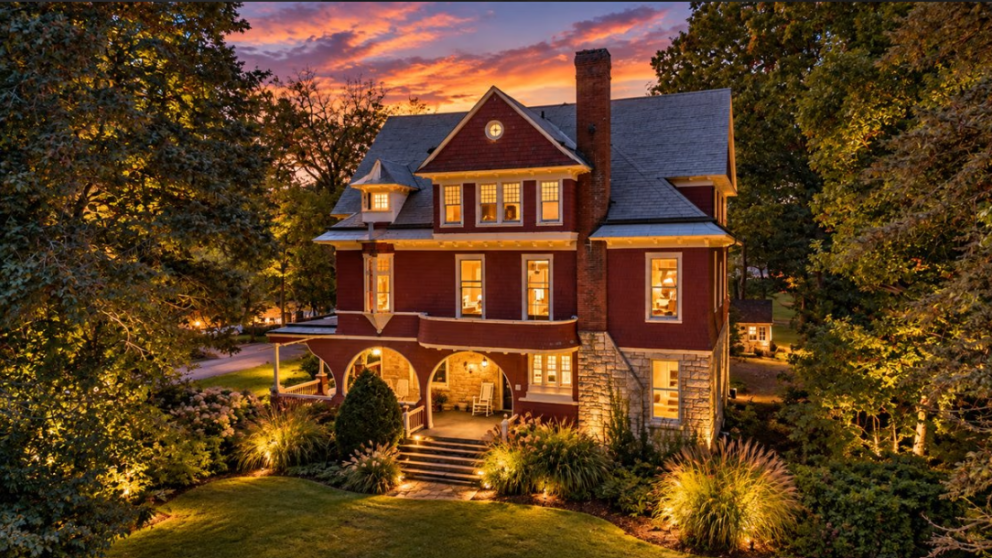
If you have ever wandered through Radford, Virginia, you may already know its silhouette: the steep gables, the deep archways of the front veranda, and the delicate oriel window catching the southwest Virginia light. This is the Harvey House, located at 706 Harvey St., Radford, VA 24141, an extraordinary late-Victorian gem built between 1891 and 1892. And now, through an upcoming auction by Farmer Auctions, this storied residence is ready to welcome its next custodian.
Born from a Gilded Dream
In the early 1890s, Radford was bustling with industrial optimism. Envisioned by boosters as the "next Pittsburgh," the town drew investors, dreamers, and craftsmen eager to build a modern mountain metropolis. Among them was J. K. Dimmick, general manager of the Radford Land Improvement Company, who commissioned the residence to reflect the grandeur of the boom era. To design it, he didn’t turn to a local builder; he retained Philadelphia master Frank Miles Day.
Day, who would later serve as national president of the American Institute of Architects and design landmark collegiate halls at Princeton and the University of Pennsylvania, brought an artist’s eye to the project. Balancing the exuberance of Queen Anne architecture with the nascent restraint of the American Arts & Crafts movement, Day treated the home as a total work of art. When the local foundry business collapsed soon after, Dimmick departed. But the house endured, waiting for the family that would truly breathe life into its rooms.
The Heartbeat of a Family Landmark
That life arrived the day after Christmas in 1906, when Lewis and Bettie Harvey moved their eight children into the residence. An early family narrative captures the magic of those years: children's laughter spilling down the grand cherrywood staircase, quiet afternoons spent reading in the library, bustling Sunday dinners in the Japanesque dining room, and summer evenings gathered on the wide front porch. For the Harvey family, this was never merely a museum piece; it was a warm sanctuary where dogs ran across the manicured lawns and generations posed together on the front steps.
That profound emotional attachment never faded. In 1974, Lewis and Bettie’s grandson, A. C. Wilson, bought the home back into direct family hands. With the help of his mother, Dilcie Wilson (Harvey), who had lovingly stashed away original fixtures, antique carpets, and lighting in the attic over decades, Wilson set out on a lifelong quest. By 1976, Harvey House had earned a rightful place on both the Virginia Landmarks Register and the National Register of Historic Places.
A Labor of Love and Evidence
Historic homes often face one of two fates: slow neglect or hasty modernizations that strip away their soul. Harvey House was blessed with neither.
Wilson approached the restoration like an archivist. Rather than picking off-the-shelf "Victorian" prints from a catalog, specialists carefully removed fireplace mantels to find preserved wallpaper scraps, re-creating the original patterns from surviving fragments. He sent salvaged fibers of original 1892 Brussels carpeting all the way to England to analyze the historic dyes and weave authentic reproductions. A paint conservator examined exterior siding under microscopes to ensure the rich color palette matched Frank Miles Day’s original vision.
Look closely throughout the home, and you’ll find:
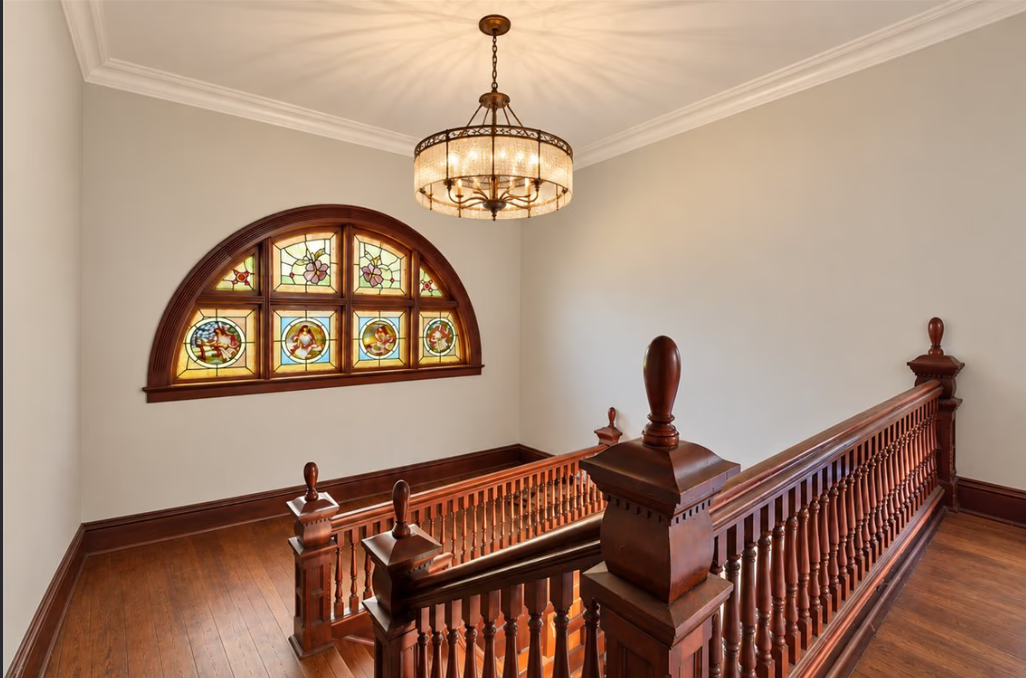
The Four Seasons Glass: An arched stained-glass bay casting jewel-toned amber, rose, and sapphire light across the upper landing.
Unbroken Light: Original 1890s window sashes with wavy cylinder glass that softly ripples the afternoon sun.
Original Carvings: Hand-chiseled panels depicting mythological and floral motifs along the staircase balustrade.
Crafted Ceilings & Radiators: Intricate 1906 pressed-tin ceilings and heavy American Radiator cast-iron radiators, sandblasted and refinished with durable, heat-resistant gold.
Beneath all this beauty lies quiet, thoughtful engineering. Wilson reinforced joists, added basement steel beams for structural stability, repointed the massive chimneys, and carefully threaded modern hydronic systems through existing floor cavities so the historic plaster and trim remained untouched.
An Ensemble of Grounds and Outbuildings
The story doesn't end at the back door. Harvey House sits in an expansive setting framed by mature shade trees, climbing wisteria, and quiet gardens. Tucked neatly into the landscape is the historic carriage house and workshop group. Wilson invested heavily in these structures, outfitting them with renewed foundations, timber repairs, updated siding, and dedicated utilities, creating a versatile footprint ideal for studio space, a private workshop, or future adaptive living.
Auction & Preview Information
Location:
706 Harvey St., Radford, VA 24141
Public Preview Date:
Sunday, November 22: 1:00 PM – 3:00 PM EST
Auction Schedule:
Online Bidding Opens: November 2 @ 10:00 AM EST
Online Bidding Closes: December 10 @ 1:00 PM EST
Live Auction Date: December 12 @ 10:00 AM EST
Writing the Next Page
For over 130 years, Harvey House has stood as a guardian of Radford’s boomtown origins and a witness to over a century of family gatherings. It represents an increasingly rare triumph: an architecturally significant, museum-grade home that still feels warm, undeniably like home.
Now, the keys are ready to be passed.
Whether you are an architectural enthusiast longing to preserve an authentic Frank Miles Day original, or someone seeking a sanctuary with deep roots and unmatched character, Harvey House awaits.
To explore property photos, view full terms, and register to bid, visit bid.farmer-auctions.com/ui/auctions/173090/26936819